
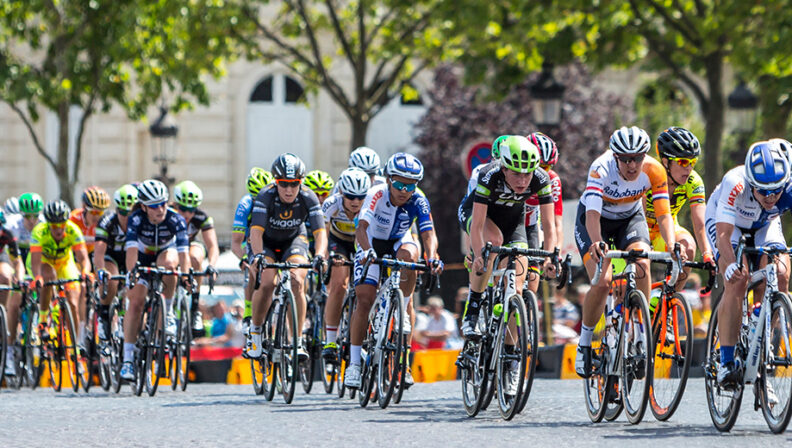
Cycling is one of the greatest team sports, as an entire team will sacrifice themselves for a single rider to win a race. Cycling functions as a team sport because drafting transforms effort into a collective asset. By drafting behind other riders, you can reduce drag by roughly 30% behind a single rider or 40% within a larger group. If you treat energy as a limited resource for each rider, you can establish strategies to minimize energy use while riding in a group.
In a cycling race, you typically see two main groups: the peloton and the breakaway. The breakaway is at the front of the race and is a smaller group of riders that expend more energy, while the peloton is a larger group in which riders expend less energy. The peloton will almost always win the race, as teams will work together to bring back the breakaway.
Breakaway tactics are a key aspect of cycling and one of the most interesting elements of its strategy. First, consider what motivates a rider or team to join a breakaway. In each peloton there are some teams with favorites, who have a much higher probability of winning the race. By creating a breakaway and getting rid of the favorites, you increase your probability of winning the race from the breakaway. A team with no favorites is therefore incentivized to have as small a breakaway as possible, since a smaller group gives each rider a higher individual probability of winning. By attacking and creating uncertainty, they also increase the variance of the race, which is advantageous to them. However, the probability of the breakaway outlasting the peloton to the finish line decreases with the number of cyclists in the breakaway, as the burden on each rider rises, so the breakaway must strike a balance in its size.
Strong teams will allow a manageable breakaway because it stabilizes the race. Without a breakaway ahead, teams without a favorite are incentivized to continue attacking by sprinting to the front of the race. This can cause irregular accelerations. Teams with favorites are forced to chase each attack, as no one else is incentivized to, leading to heavy energy expenditure. On the other hand, with a manageable breakaway ahead, teams with favorites can have their other riders hold a constant speed and ensure that their team spends the minimum amount of energy before the finish line. Teams without favorites are no longer incentivized to continue attacking, as they will either already have a rider in the breakaway or there will not be enough teams without a favorite left to form another successful breakaway. The arrangement aligns the incentives of the two groups. The favored teams save energy while maintaining control, and smaller teams gain exposure and a real chance.
Within a breakaway, the tactics are also interesting. This situation resembles a repeated Prisoner’s Dilemma. When in the breakaway, a rider can decide either to cooperate and take turns riding on the front of the group or to defect and skip their turn at the front. Cooperation allows all members of the breakaway to use energy more evenly to stay away from the peloton and increases the chances of winning for all participants. Skipping a turn allows a single rider to save energy and attack the breakaway later, thereby increasing their probability of winning. In fact, most riders end up playing a tit-for-tat like strategy. They cooperate for most of the race, until one rider judges that the probability of the breakaway winning is either very high or very low. At that point, they start skipping turns in preparation for an attack from the breakaway, and cooperation evaporates. Another interesting aspect is that a rider can bluff fatigue to skip a turn on the front, thereby saving energy without immediately prompting the others to do the same.
Team tactics within a breakaway are a whole different consideration. An interesting example of this is Dwars door Vlaanderen 2025, where the American rider Neilson Powless won. In the race, there were four riders in the breakaway who had a large enough gap from the peloton to make it to the finish without being caught. Three of the riders were Wout van Aert, Matteo Jorgenson, and Tiesj Benoot all from Visma | Lease a Bike, while Powless was the only rider from EF Education-EasyPost. Arguably optimal play required rolling attacks. By sending riders off one by one, Visma–LAB could have forced Powless to chase repeatedly and eventually crack, which would likely have delivered the win to one of their three. Instead, the team maintained a unified pace and committed to a sprint. That choice provided Powless with an efficient ride to the line. He stayed patient, launched at the right moment, and out-sprinted van Aert.
Another interesting example of breakaway tactics occurred in the 2025 Women’s World Championship Race. The initial breakaway was slowly whittled down to just three riders with approximately 22 km remaining: Niamh Fisher-Black, Magdeleine Vallieres, and Mavi García. The peloton behind hesitated. Each nation waited for the other to invest riders in the chase, which produced a stalemate and allowed the leaders to build time. On the final climb, Vallieres attacked her companions, established decisive separation, and won. The outcome illustrated how divided incentives and delayed commitment in the peloton can turn a catchable move into the race-winning one.
Cycling strategy depends on coordinated energy management and timely aggression. For deeper race-by-race tactical analysis, the Lanterne Rouge YouTube channel offers high-quality breakdowns.



Subscribe Now
Get each new post sent straight to your inbox