

In December 2024, Coin Poker hosted the Cash Game World Championship, spreading 50/100 tables with a 100bb minimum buy-in that attracted many of poker’s top online players, including Linus Love, Pr0digy, DavyJones992 and other high stakes legends who have been dominating the scene for years. The twist? All action took place on show tables, which meant every winning hand had to be revealed regardless of on which street the hand ended.
This rule completely changed the dynamic. In normal games, hands go to showdown around 20% of the time, so in this configuration hands were being exposed 5x as often. Players could immediately see if their opponents were deviating from a game-theory optimal (GTO) approach, which forced back-and-forth adjustments. This game format highlighted a timeless truth of poker: decision-making revolves around identifying other players’ tendencies and making exploitative adjustments to maximize expected value (EV). Normally, these meta shifts unfold over longer periods of time, and it could possibly take thousands of hands to pick up what your opponent is doing. But, with the show tables, deviations were exposed more often, forcing players to adjust quicker.
By the end of the event, 24-year-old Owen “Pr0digy” Messere – once a rising chess talent, now one of poker’s sharpest minds – sat atop the leaderboard. He has since appeared on many poker podcasts/interviews, so he has shared a fair bit of his poker philosophy in public. I picked a hand that showed how far he was willing to take his reads, even if sometimes it didn’t work out. In this hand, Pr0digy plays a 3-bet pot against Kevin “TaxHere” Paque, who has been around the high-stakes scene for decades. We’ll analyze this hand from Pr0digy’s perspective.
Hand History:
Coin Poker 50/100 $11,800 effective
TaxHere (BTN) raises to $250, Pr0digy (BB) raises AJcc to $1300, TaxHere (BTN) calls
($2600) KsKd3h Pr0digy bets $1192, TaxHere calls
($5034) 5d Pr0digy bets $3322, TaxHere raises all-in $9308, Pr0digy calls
[Preflop] TaxHere (BTN) raises to $250, Pr0digy (BB) 3-bets AJcc to $1300, TaxHere calls:
When Pr0digy 3-bets the big blind, he’s repping a polar range – hands that are either very strong or very weak. This approach makes sense from the BB because we have the option to call and see a flop for just 1.5bb. So, when we choose to 3-bet instead, we’re signaling that our hand is strong enough to pass up the cheaper route and that we prefer to build up a bigger pot. The sizing reinforces this; a 13bb 3-bet is on the larger side and tells the story that we are representing a polar strategy.
Even at these stakes, players make pre-flop deviations, and it’s not just a matter of who has memorized their charts the best. For example, the optimal 3b frequency for A5o is around 20%, but if you believe that your opponent is under-defending against a 3b or their button open range is wider than theory suggests, we can bump that frequency up to 75%. In this hand, Pr0digy 3-bets AJcc – a hand that plays well as a flat but also makes the cut as a value hand in our polar 3-bet range.
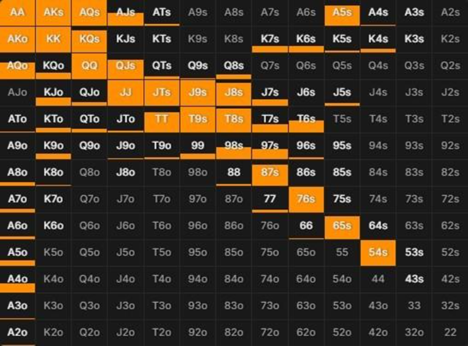
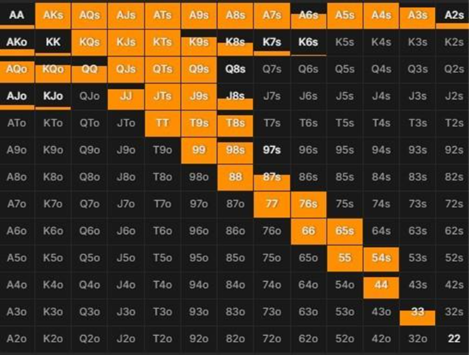
TaxHere decides to call. For this hand analysis, I assumed a GTO range for both players since I wasn’t confident whether either player was making deviations preflop.
I assigned the BB this range:
I assigned the BTN this range:
[Flop] ($2650) KsKd3h Pr0digy bets $1192, TaxHere calls:
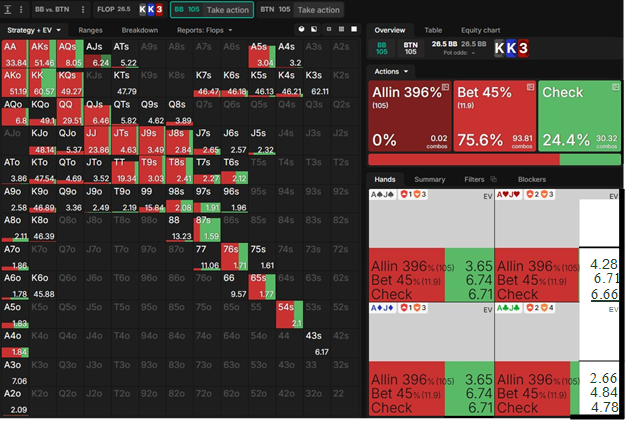
Pr0digy starts out with a 45% pot sized continuation bet (c-bet) on KsKd3h. In his interviews on the Coin Poker Youtube channel, Pr0digy is clearly an advocate of using a single size flop c-bet strategy. This means that Pr0digy’s only 2 options are to check or bet 45% pot with his entire range. This is a common approach taken by many high stakes players for two reasons.
First, introducing 2 sizes only marginally increases the EV of your strategy. If I were to give the solver the option to bet 45% and 75% of the pot, the EV of the BB’s range goes from 14.64 to 14.65, which is a negligible change. Second, adding a second sizing makes the strategy significantly harder to execute. It forces us to add another branch earlier in the game tree for not much reward. If we’re not playing a balanced 2 size strategy, good players will be able to quickly identify if we’re bucketing weak hands in one sizing scheme and strong hands in the other, especially on these show tables. This is why many high stakes regulars opt to use a 1 sizing scheme on most flops. This is also an important distinction to make when analyzing the hand because if we know Pr0digy is not splitting sizes, we can assume he has strong and weak hands in the 45% sizing scheme.
KsKd3h is a good flop for the out-of-position (OOP) player, which is the BB here. OOP has a large advantage in the top end of their range, with trips about 14% of the time compared to the button’s 10%. On this board, OOP should bet 75% of their range. The main hands that prefer to check are low equity hands like 65cc 98cc, A5o A6o. Here, Pr0digy chooses to c-bet AJcc.
Pr0digy (OOP) Flop betting range:
TaxHere (IP) Flop defend vs betting range:
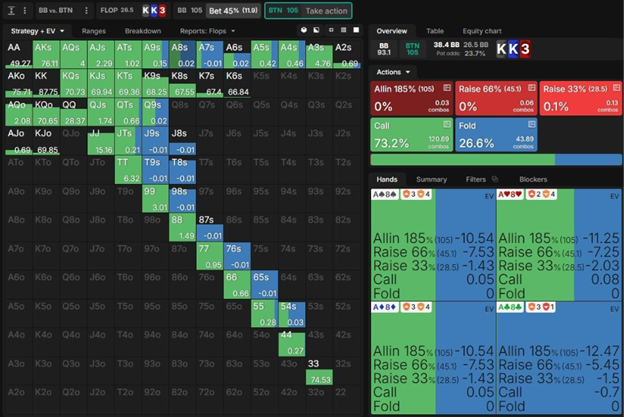
It’s possible TaxHere could be making deviations on his flop defend. The main bucket of hands that have room for exploitative play are approximately 0 EV calls: A8-A6 with a backdoor flush draw, and Q9s with a backdoor flush draw. As you can see in the screenshot, a hand like A8ss goes for a call (0.05 EV) and fold (0 EV).
In the in-position (IP) player’s shoes, if you’re playing against an OOP player that c-bets too much, the exploitation is to call these indifferent hands more. If you think that the OOP player is not c-betting enough and checking too many of their weak hands, it would be better to fold a hand like A8ss. If I had to take a lean one way, I would assume that TaxHere is exploitatively going to call these 0EV hands more than theory suggests. If anything, Pr0digy will be over bluffing the BB 3-bet configuration preflop, which adds more weak hands in his range. Also, I would take the over 75% on Pr0digy’s c-bet frequency because it is likely the population c-bets K-high boards too much on average in these positions.
[Turn] ($5034) KsKd3h5d Pr0digy bets $3322, TaxHere raises all-in $9308, Pr0digy calls
Pr0digy decides to fire a second barrel on the turn with AJcc. This is a good barrel candidate because the IP’s main hands that are indifferent between call and fold are AQo, 99-44. These are all hands that AJs benefits getting folds from. Also, clubs are good suits to barrel because we unblock backdoor flush draws on the flop that will now fold the turn like A9hh and QTss.
Sure, these are hands we beat, but it is very unlikely we go to showdown against worse A high and Q high hands because it’s likely IP bluffs these hands if we check at some point. So, there is some value in winning this bluffing war with AJcc by just barreling turn.
Pr0digy (OOP) Turn betting range:
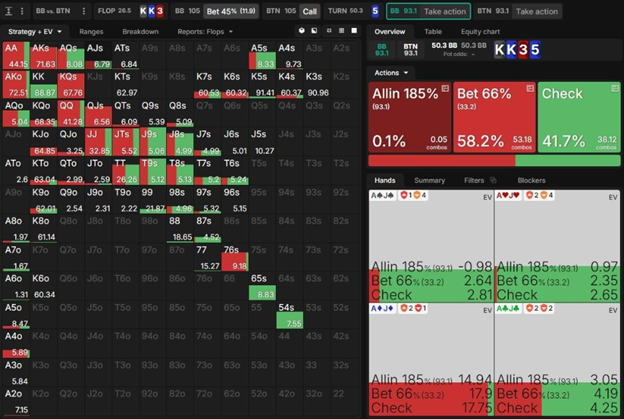
In Pr0digy’s shoes, it’s possible that he can refrain from bluffing a hand like AJcc because if TaxHere thinks Pr0digy will overbluff this spot, then he will call with AQo, which makes the EV of bluffing AJcc go significantly down.
TaxHere (IP) Turn defend vs betting range:
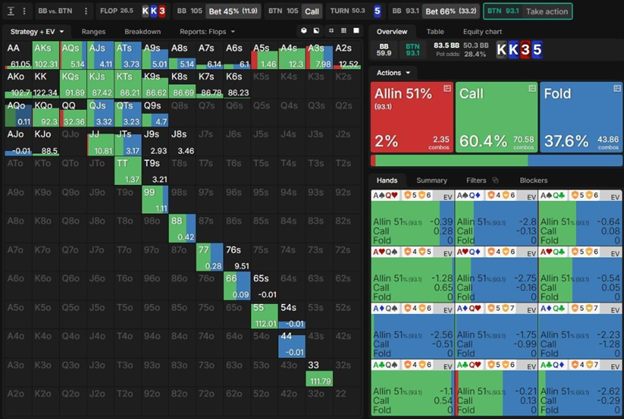
Pr0digy probably barelled because he thought that TaxHere was going to fold AQo most of the time. If his assumptions are wrong and TaxHere was actually calling AQo, the EV of bluffing AJcc would go from winning 4bb to losing 2bb.
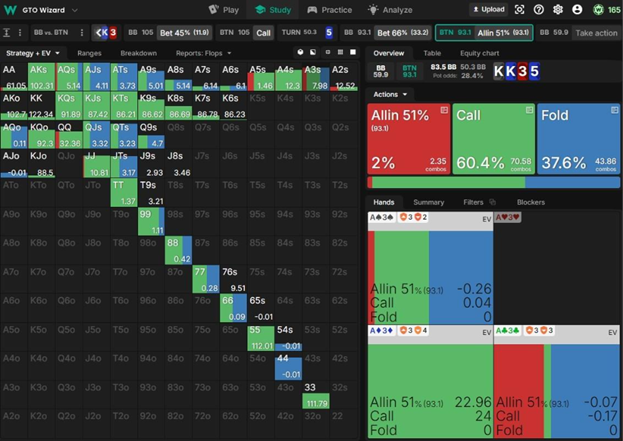
TaxHere decides to jam against Pr0digy’s second barrel, and Pr0digy surprisingly calls it off. In theory, calling off AJcc loses 14bb, which is a huge losing play. If I had to guess why Pr0digy called, he likely thought that TaxHere’s stong hand wouldn’t jam because he wanted to give Pr0digy a chance to fire a third barrel on the river. So, he likely thought a large percentage of TaxHere’s range contained flush draws that were trying to make Prodigy’s AQ, QJ, and JT type of bluffs to fold. Pr0digy likely concluded that TaxHere’s jam doesn’t make much sense to do with value and that leaves with him with more bluffs.
This hand is a prime example of how players can just decide to ignore theory, make a read as simple as putting their opponents on a flush draw, and call with a marginal hand. TaxHere makes a very sharp play and finds one of the few theory jams with A3s. This is a jam in theory because A3s doesn’t improve on many rivers, it denies bluffs like QJ JT from realizing their 2 overcard equity and his kicker doesn’t play on a river A. It’s likely that TaxHere decided to pure jam this hand because he thinks that Pr0digy is bluffing too much. The EV of jamming A3s goes up if the opponent has more bluffs because bottom pair benefits from yielding folds rather than making a tough decision on the river.
Header photo credit: PokerGO


Subscribe Now
Get each new post sent straight to your inbox